I certainly was not naive to think that this blog was based on completely original thought. In fact, it intentionally alludes to absolute or ultimate concepts, which have direct relation to philosophy. However, let this be a disclaimer to all readers: Consider this blog more as a call to education, action, and change than as a purely philosophical discussion. It is an appeal to the masses for the sake of inspiring deep thought on social issues, because if more people educated themselves on and deeply analyzed these issues, the more potential we'd have in reaching a higher plane of morality.
With that, let us talk about education.
The last post stated that a government should take into account that all of its citizens will likely not have access to the same resources, but it should not let this condition hinder citizens from fulfilling their basic needs. Maslow's hierarchy of needs was alluded to before in describing these basic needs, which seem much more fitting and concrete as a foundation for governing than do unalienable rights. According to Maslow, needs evolve according to achievement. When an individual has fulfilled needs having to do with survival, he turns to emotional needs (wikipedia.org). For example, if humans in Siberia were being actively hunted by tigers during a famine, they would surely preoccupy themselves with attaining sustenance and protection than, say, social belonging. The opposite can be said for a typical New York City investment banker for who can take survival needs for granted.
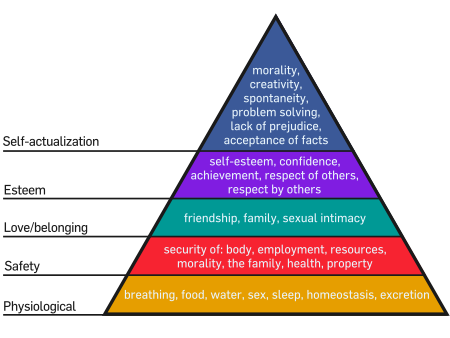 http://upload.wikimedia.org/wikipedia/commons/thumb/6/60/Maslow%27s_Hierarchy_of_Needs.svg/450px-Maslow%27s_Hierarchy_of_Needs.svg.png
In the United States and other lands influenced by the West, learning has taken the more formal role of academic schooling, and is universally mandated. Because this education has so much to do with esteem in these societies, mandating enables a vital means to an inherent need for all citizens. Still, academic education is only vital because of the value placed on it in Western societies. Let's show how much we value human rights by including the study of morality, objective and scientific, in this universal education.
References
http://en.wikipedia.org/wiki/Maslow%27s_hierarchy_of_needs

No comments:
Post a Comment