Sunday, November 8, 2009

Wealth

Some may consider the elimination of monetary incentives for work as socialist in some ways. It does indeed fall in line with equal distribution of wealth across a population. And as a result, there would be no hierarchy of professions defined by economic status. Doctors, lawyers, and professors would have the same income and privileges as factory workers, janitors, and department store clerks. And perhaps there would then be a greater diversity of professions in general. Those that truly wanted to be musicians may not have to settle for it being a hobby so they can pursue "real" careers. People would be intrinsically motivated to fulfill their true desires, rather than motivated by material means. Whether social hierarchy will be completely extinguished, however, is debatable, as the issue surely goes deeper than wealth. Yet, equal wealth distribution would be a step in that direction.

It would be interesting to observe how eliminating monetary incentives would affect certian institutions and people's productivity. People may be inherently lazy, and choose jobs that don't require much effort, which is fine theoretically. But if such happens on a mass scale, fields that require advanced and special skills may decline. People often say, "I like to stay busy", but whether this trait is something learned or inherent is up for discussion. It may be that these same people simply became used to the U.S. culture of working hard or being in a time crunch and never truly experienced being able to sit back and relax. Whatever the case, the value of education could be in serious question when it doesn't matter where you end up after schooling anyway.

One could make the argument that in capitalistic societies, salaries are proportional to the amount of "good" one does for society. Being a janitor is noble, but cleaning requires no significantly unique skills, new innovations, nor are its effects broad reaching. Doctors, lawyers, and investment bankers, however, affect the advancement of medicine, justice, and the economy respectively, and all these professions require special, learned skills. Even those who advance the world of art, entertainment, or sports receive monetary rewards correlated with the individual's skill and how many people they affect. And surely, these professions are just as legitimate as those formerly mentioned.

The difference comes at the extremes. Namely, there is correlation, but it is not proportional. Derek Jeter's salary went from $11,000,000 in 2001 to $21,600,000 this year (sports.espn.go.com). Yes, what he does is spectacular, even arguably worth millions, but definitely not $21,600,000. And he is getting paid twice as much for aging 8 years and and possibly getting worse. Derek Jeter is the reason no one goes into education. Your favorite elementary school teacher proably makes five hundred times less than Jeter, his superintendent a little more than that, and any higher administrators a little more than that. The same discrepancy exists between CEOs and family doctors, and many other professions. Thus the bias is revealed and consequently the flaw in the money incentive. Rather than achievement defining the reward, it very much acts the other way around. The prospect of wealth can and does compromise people's intentions. If you want proof, look no further than big tobacco's advertising campaigns.

References

http://sports.espn.go.com/mlb/players/profile?playerId=3246

Sunday, November 1, 2009

Motivation and Progress

The last post talked about progress as opposed to evolution and briefly explored the question of why we progress. The working definitions established were that evolution is a form of progress that is involuntary because it is controlled by factors that determine survival. Progress can be voluntary however, but if so, should not be deemed evolution. Furthermore, any progress beyond evolution is voluntary, even though it may not be practiced as such. To clarify, consider the following example:

More buildings in tornado and hurricane prone areas accomodate storm shelters to protect inhabitants from these dangerous occurences, while more luxury condominiums are being erected in Harlem, NY to appeal to a new influx of wealthier residents.

The latter example of gentrification may be considered progress to some, as it could benefit those in real estate by boosting property values and attracting new businesses to the area. However, the typically lower-income, native Harlem residents may have an opposite take on the issue, as they may see less available affordable housing, rising rent prices, and people being pushed out of their homes as a detriment to Harlem instead. As a long time Harlem resident, these opinions are not assumptions, but come from first-hand experience.

Perhaps providing more affordable housing would be considered progress to native Harlem residents. Whatever the case, this example contrasts the first example about storm shelters, because most if not all people would agree that storm shelters are not simply a good idea, but are necessary to ensure the safety of residents in those areas. Furthermore, those without storm shelters are subject to physical harm and possibly death, which follows the protocol for evolution, that is, those without traits necessary for survival are eliminated. This fact demonstrates another important distinction between evolution and progress: evolution always occurs in groups, whereas progress does not have to.

In fact, since definitions of progress can conflict between people and populations, progress beyond evolution should always occur on an individual level unless the definition of progress aligns amongst a group of individuals. Such is not the case across the world and most certainly not in the United States, as value systems impose controversial precedents for progress from the top down. People are forced to work for corporations whose philosophies may not parallel their own. People are driven by the prospect of wealth rather than personal fulfillment. Perhaps the notion of working for what you believe in is only available in an ideal society. Nonetheless, its absence from the present proves that currently these societies are not perfect. Throughout history struggles for self-determination have occurred, but apparently, the fight is not over.

Monday, October 26, 2009

Why progress?

It can be argued that progress is a natural way of life. Evolution is a form of progress that governs all forms of life. In order to survive, every life form must be sufficiently equipped to obtain essential nutrients and avoid predation or other dangers. If the species cannot survive to reproductive age, then it simply cannot continue to prosper in future generations. However, after a species has attained a sufficient population growth rate, it is no longer pressed to biologically evolve any further. Since this need is fulfilled, perhaps other forms of progress or evolution become more prioritized in our minds, just as our other needs become more prioritized according to Maslow, a concept which was discussed in the previous post.


Progress can surely take on many different forms and meanings for different people. One can look at progress in spiritual sense, such as the individual striving for self-transcendence; a scientific sense, such as using new technologies to solve problems more efficiently; and of course a social sense, such as attaining new universal liberties, among others. Progress can also be on the individual level as well as the group level. But this idea of progress beyond one's objective need is something that is important to explore for the simple fact that it can be perceived so differently by so many different people.

Among nations, a major form of progress is prosperity in comparison to other nations. For example, currency, industry, and military prowess are examples of ways one nation can assert its superiority over other nations. This concept of competition can be seen as a large driving force for many non-Western nations to industrialize. The capitalist mentality that has been traditionally Western, has spread to countries such as Japan and China, for instance (morningstar.com). Becoming a superpower is an understandable goal, especially since we are still warring peoples, as is evidenced by the current war in Iraq. And every nation should therefore have some sort of means of protecting itself from impositions by other nations. What many may consider progress may therefore be considered evolution or Darwinism in a different sense.


Perhaps when there is total world peace or when a worldview exists that is wholistic rather than from the view of a nation, we can focus on other types of progress, or perhaps the lack thereof. From what has been discussed in this post, it might be fairly concluded that progress differs from evolution in that progress has the potential to be voluntary, whereas evolution cannot. Not driven by a need for survival, motivation for progress, therefore, must come from elsewhere. We have seen how progress can be individualistic or broader reaching. However, progress after meeting one's survival needs must always be voluntary.

References
http://news.morningstar.com/articlenet/article.aspx?postId=2695223

Sunday, October 11, 2009

What's education got to do with it?

So I was talking about this blog with a friend the other day, and we got to discussing American political thought as well as written works by some prominent philosophers, topics that this friend is currently studying but that I hadn't touched since middle or high school. As my friend and I were talking, I realized that many of the issues in my posts has already been thought of, documented, debated ad nauseum, and expanded upon extensively. The realization was humbling, yet inspiring as well.

I certainly was not naive to think that this blog was based on completely original thought. In fact, it intentionally alludes to absolute or ultimate concepts, which have direct relation to philosophy. However, let this be a disclaimer to all readers: Consider this blog more as a call to education, action, and change than as a purely philosophical discussion. It is an appeal to the masses for the sake of inspiring deep thought on social issues, because if more people educated themselves on and deeply analyzed these issues, the more potential we'd have in reaching a higher plane of morality.

With that, let us talk about education.

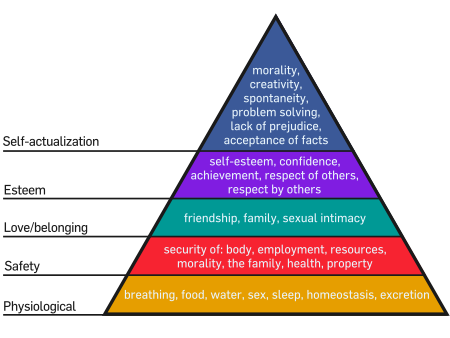
The last post stated that a government should take into account that all of its citizens will likely not have access to the same resources, but it should not let this condition hinder citizens from fulfilling their basic needs. Maslow's hierarchy of needs was alluded to before in describing these basic needs, which seem much more fitting and concrete as a foundation for governing than do unalienable rights. According to Maslow, needs evolve according to achievement. When an individual has fulfilled needs having to do with survival, he turns to emotional needs (wikipedia.org). For example, if humans in Siberia were being actively hunted by tigers during a famine, they would surely preoccupy themselves with attaining sustenance and protection than, say, social belonging. The opposite can be said for a typical New York City investment banker for who can take survival needs for granted.

http://upload.wikimedia.org/wikipedia/commons/thumb/6/60/Maslow%27s_Hierarchy_of_Needs.svg/450px-Maslow%27s_Hierarchy_of_Needs.svg.png

This model is very important because it is applicable to most if not all people, as it describes undeniable traits of our natural human personality. One can free himself from the binds of these needs, however, through learning. What is meant by "learning" here is the processing and internalizing of oneself and surroundings in order to create a mental database of information and shape future behavior. Learning is thus crucial for intrapersonal reflection and value judgment, which are the keys to esteem, the second highest need according to Maslow. Esteem allows the individual to decide for himself his own hierarchy of values. Moreover, learning, and thus esteem, is highly influenced by an individual's society, which is evident by culture differences between the East and West.

In the United States and other lands influenced by the West, learning has taken the more formal role of academic schooling, and is universally mandated. Because this education has so much to do with esteem in these societies, mandating enables a vital means to an inherent need for all citizens. Still, academic education is only vital because of the value placed on it in Western societies. Let's show how much we value human rights by including the study of morality, objective and scientific, in this universal education.

References
http://en.wikipedia.org/wiki/Maslow%27s_hierarchy_of_needs

Sunday, October 4, 2009

What is the role of a government?

To rely on a method of governing solely based on science and logic may seem radical to some. Emotions and values play such an important role in our enjoyment of life that to strike them from decision making is like stifling life itself. In Star Trek, Spock fought his anguish after his mother died so as not to "emotionally compromise" himself and his ability to command his ship. Absurd. Should he not have the privilege to grieve for a loved one?

Ideally, logic and science should only be used in law-making and limited at the level of the government. Private interests should never be restricted so long as they do not cause a significant detriment to others. Such is the case in the U.S. now although it's far from perfect. Law dictates many regulations, but they rarely fully coincide with an individual's personal morals. Thus, people decide for themselves what they deem to be a proper code of conduct. Still, it is important that citizens hold their government to higher and more consistent standards than any individual.

But what does this mean for individual sovereignty? It is a serious question that fundamentally defines the purpose of a government itself. How much influence on individual affairs should a government impose?

This issue is one of several that separate republicans from democrats, capitalists from socialists. To protect individual interests, government should have a minimal role in people's everyday lives. A person should ultimately be able to choose for himself what type of life he wishes to lead, whether it be religious, athiestic, scholarly, athletic, healthy, gluttonous, wealthy or impoverished. Republics would argue that the United States provides enough venues for anyone to achieve either of these lifestyles. But do they? Reducing government influence also reduces government accountability. This burden of accountability then falls to individuals, which leaves much room for discrimination, as individuals may be biased by their own personal ideologies. Certainly, we have seen this phenomenon happen countless times in the United States and all over the world.

Protecting individual interests is only one part of a government's role. But what is fundamental about humans is that we do not live individually. No, it is probably safe to say we are inherently social animals. Nevertheless, as is shown by our fundamental needs or rights, we are inherently selfish as well. Perhaps these traits were necessary for our survival according to evolution. Nevertheless, a government should take into account both of these factors of human behavior and find the best way to balance them. Some may say, then, that a government's role is ultimately to equally govern the selfishness of its constituents.

The fact of the matter is everyone will not have access to the same resources, and the government should not let this hinder individuals from fulfilling their inherent needs.

Sunday, September 27, 2009

What is morality? Part Deux

So the last post suggested the possibility of human society or at least the United States moving toward purely logic-based reasoning, likening law to a science rather than a form of influence subject to personal ideologies. By removing illogical influences such as religion and emotion, law will have no choice but to surrender to completely objective reasoning, and thus cannot be disputed. No wars, no uprisings, complete peace on Earth, right?

But is it really that easy?

The golden rule is considered among many to be the most basic principle for living a noble life. The Declaration of Independence stated that certain unalienable rights were "life, liberty, and the pursuit of happiness." Great. Most rational human beings can agree to these, but in fact, what is unique about morality and law is that, unlike science, anything can be disagreed upon. There is no "majority rules" in science. Rather, it is the study of fact: what is and what can be. Morality is based on opinion: what should be. Therefore, unlike science, rights can only be declared, never proven.

So maybe there is a reason to all the competing ideologies out there. Maybe subjectivity is inseparable from morality and law, even at the most basic level. And maybe then, the sluggishness of advancement in human rights is justified and unchangeable, and this blog is futile...

:(

But wait.. There may be a solution. Instead of comparing science and morality, perhaps they need to be fused. In order to do this, humans must be recognized not as sovereign beings who are above all laws governing the universe, but merely as glorified animals who occupy a certain niche and are just as subordinate to influences as any other unit of life or matter. Therefore, humans need to be studied, analyzed, and documented in order to determine what is truly best for them and what are true unalienable rights. "Best" here refers to the common good and remains an opinionated term, yet it becomes much more objective if based on scientific facts, rather than mere declarations.

This is certainly not a radical idea. In many ways, the U.S. already implements laws based on this method of reason, but they are largely limited to public health regulations. This makes sense. Science governs laws about science. The FDA and other health care organizations are instrumental in making these regulations based on sound research.

But, again, what about these so-called "unalienable rights"? Where is it proven that humans need or deserve these rights? Why isn’t the right to reproduce included? Surely that is essential to the prosperity of all life. What is “freedom” anyway?

These rights represent worthy ideals, sure. But why not take it a step further and justify them through scientific conclusions about the human race and remove the question of validity? For example, Maslow’s Hierarchy of Needs ranks a list of human needs based on research using responses from human subjects. It demonstrated inherent human values that were applicable across the broadest range of individuals, independent of personal ideologies. If studies like this were used in law-making, it may be surprising as to what really are the most logical ways in which we should govern ourselves.

To end, let me leave you with this video that analyzes free will. It may be somewhat unsettling at first, but eye-opening nonetheless.

Sunday, September 20, 2009

What is morality?

The last post posed the question of why the progression of human rights is so slow compared to that of science and technology. This post will expand on this issue a little more and discuss more specifically the concept of objectivity, or lack thereof, in determining law and human rights today. In order to explain this, it’s necessary to refer to a quote from a reputable, scholarly source, which says:


"Emotions run deep within our race. In many ways more deeply than in humans. Logic offers a serenity humans seldom experience. The control of feelings so that they do not control you."

The wise man who said this was Sarek, Spock’s father in the latest installation of the Star Trek movie series. He said this as words of advice to his son, Spock, who was undergoing an internal struggle throughout the movie, deciding whether to embrace his emotions or to reject them. A little context: Spock, who is a mix of two races, has a human mother and a Vulcan father. The Vulcan race hails from the planet Vulcan, and they practice the tradition of purging themselves of all emotion. This tradition “frees” their race from emotional binds so that they can make “better” decisions, based purely on logic. In this movie, Spock actually opts out of this Vulcan tradition and joins the human space military academy, Starfleet, instead of entering a Vulcan university and following in his father’s path.

Yes, this is a movie… And a fantastical one at that. But science fiction is a genre that is known to build upon the theories of science, in effect actuating in film and literature what scientists can only dream of. So for the sake of a blog that promotes forward thinking, what better source to reference than Star Trek, right?

The movie attempts to decipher what is truly the greater good. In the Vulcan sense, the greater good can only be determined through a rationale that is devoid of all emotion. Logic should prevail at all times, and thus there can only be one sensible solution to any problem. Therefore, an absolute greater good is easily identifiable, just like a solution to a math problem. If this type of reason were applied in a social sense on Earth, surely there would never be reason for war or conflict of any sort, and human rights would be indisputable.

One could argue that this type of society is exactly what we as humans are moving towards. The first evidence of this is the separation of church and state, which officially recognized the two as independent institutions and removed the church’s influence on state affairs. While illegal, however, it is still evident that religion does play a part in law establishment and policy making today, as it serves as the basis of much of our reason as individuals. So, while abortion is legal in the United States, it faced an incredible amount of opposition at the state and grassroots level, and still does, due undoubtedly to a major stigma imposed by churches, but affirmed by individuals. Religion, thus, shapes our values and emotions. So is the separation of church and state a start to the eventual separation of emotion and state, and possibly emotion and reason altogether?

If this is true, then what would morality and law be based on in the future, if not religion? Perhaps it would take the road of Descartes, a French philosopher who completely reeducated himself according to logical principles, the first of which being “I think, therefore I am.” The starting point for morality and human rights may very well be none other than the Golden Rule, “Do unto others, as you would have them do unto you.”

Food for thought, indeed. But so as not to bore you with length, this discussion will have to continue next time. Till then!

Sunday, September 13, 2009

What is "progress" anyway?

Ask different people, and you'll surely get different responses. Ultimately, there is no definite answer but the answer we make for ourselves. Yet it is important that, as a world civilization, we have some sort of consensus about ways in which we wish to advance ourselves.

You have probably envisioned to yourselves how the world will be in twenty.. fifty.. even a hundred years. What technological breakthroughs will have occurred? Flying cars? Teleportation? What things we currently practice will be abolished and considered atrocities of the past? Alternatively, what will be commonplace or legalized that we consider atrocities now? What new values will we hold dear, and what others will we have abandoned?

In order to answer these questions, we must be able to learn from our past as well as constantly look towards our future. We must be forward thinkers.

A doctor once told me, during a talk on stem cell research, that he does not approve of the research not because of the "baby-killing" argument, but because he feared what the future would hold for further "advances" in that area. He noted that the past has taught us that humans will use use technology unchecked, which have led to disasters such as the Hiroshima and Nagasaki. Chernobyl and the Challenger accidents. Global warming. So what's to stop scientists from cloning humans soon, if they haven't already in some underground lab? The CIA LSD experiments were kept secret for decades, as was their infusion of crack cocaine into Black communities. All it takes is for someone to justify it.

During this talk, the doctor said one thing that will probably stick with me forever. And that was:

"Our technology is evolving much faster than our morality."

Deep, right?

Think about it. Slavery in the United States was abolished only 150 years ago, yet institutionalized discrimination still exists. Blacks received the right to vote shortly after, but women were excluded until 1920. Are you kidding me? Guns, cars, and lightbulbs were well established by then. In 1960, the television or radio was a staple in many U.S. homes, but women were confined to the kitchen. It seems that while science is advancing exponentially, morality is doing so logarithmically... (Calculus, anyone?)

Well, this is a HUGE problem.

But what is the difference between science and morality? What is holding morality back?

A large part of it must be that science is vastly more objective. Certainly, as is taught by history, evolving morality is hindered by tradition, stubbornness, and special interests. Why else hasn't the U.S. already adopted universal healthcare?

This blog is an attempt to combat this sluggish trend of improving human rights by promoting foward thinking about moral issues we face today. It will discuss the past, present, and future in order to provoke thought on a deep level about where we have come from, where we are, and where we are going as a civilization and human race. Perhaps you, the readers, will be inspired to think more about what exactly is "progress" and to work together to identify a true greater good.

The world needs forward thinkers because, after all, the future is now.