Monday, October 26, 2009

Why progress?

It can be argued that progress is a natural way of life. Evolution is a form of progress that governs all forms of life. In order to survive, every life form must be sufficiently equipped to obtain essential nutrients and avoid predation or other dangers. If the species cannot survive to reproductive age, then it simply cannot continue to prosper in future generations. However, after a species has attained a sufficient population growth rate, it is no longer pressed to biologically evolve any further. Since this need is fulfilled, perhaps other forms of progress or evolution become more prioritized in our minds, just as our other needs become more prioritized according to Maslow, a concept which was discussed in the previous post.


Progress can surely take on many different forms and meanings for different people. One can look at progress in spiritual sense, such as the individual striving for self-transcendence; a scientific sense, such as using new technologies to solve problems more efficiently; and of course a social sense, such as attaining new universal liberties, among others. Progress can also be on the individual level as well as the group level. But this idea of progress beyond one's objective need is something that is important to explore for the simple fact that it can be perceived so differently by so many different people.

Among nations, a major form of progress is prosperity in comparison to other nations. For example, currency, industry, and military prowess are examples of ways one nation can assert its superiority over other nations. This concept of competition can be seen as a large driving force for many non-Western nations to industrialize. The capitalist mentality that has been traditionally Western, has spread to countries such as Japan and China, for instance (morningstar.com). Becoming a superpower is an understandable goal, especially since we are still warring peoples, as is evidenced by the current war in Iraq. And every nation should therefore have some sort of means of protecting itself from impositions by other nations. What many may consider progress may therefore be considered evolution or Darwinism in a different sense.


Perhaps when there is total world peace or when a worldview exists that is wholistic rather than from the view of a nation, we can focus on other types of progress, or perhaps the lack thereof. From what has been discussed in this post, it might be fairly concluded that progress differs from evolution in that progress has the potential to be voluntary, whereas evolution cannot. Not driven by a need for survival, motivation for progress, therefore, must come from elsewhere. We have seen how progress can be individualistic or broader reaching. However, progress after meeting one's survival needs must always be voluntary.

References
http://news.morningstar.com/articlenet/article.aspx?postId=2695223

Sunday, October 11, 2009

What's education got to do with it?

So I was talking about this blog with a friend the other day, and we got to discussing American political thought as well as written works by some prominent philosophers, topics that this friend is currently studying but that I hadn't touched since middle or high school. As my friend and I were talking, I realized that many of the issues in my posts has already been thought of, documented, debated ad nauseum, and expanded upon extensively. The realization was humbling, yet inspiring as well.

I certainly was not naive to think that this blog was based on completely original thought. In fact, it intentionally alludes to absolute or ultimate concepts, which have direct relation to philosophy. However, let this be a disclaimer to all readers: Consider this blog more as a call to education, action, and change than as a purely philosophical discussion. It is an appeal to the masses for the sake of inspiring deep thought on social issues, because if more people educated themselves on and deeply analyzed these issues, the more potential we'd have in reaching a higher plane of morality.

With that, let us talk about education.

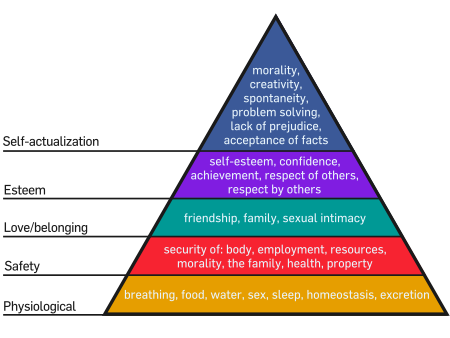
The last post stated that a government should take into account that all of its citizens will likely not have access to the same resources, but it should not let this condition hinder citizens from fulfilling their basic needs. Maslow's hierarchy of needs was alluded to before in describing these basic needs, which seem much more fitting and concrete as a foundation for governing than do unalienable rights. According to Maslow, needs evolve according to achievement. When an individual has fulfilled needs having to do with survival, he turns to emotional needs (wikipedia.org). For example, if humans in Siberia were being actively hunted by tigers during a famine, they would surely preoccupy themselves with attaining sustenance and protection than, say, social belonging. The opposite can be said for a typical New York City investment banker for who can take survival needs for granted.

http://upload.wikimedia.org/wikipedia/commons/thumb/6/60/Maslow%27s_Hierarchy_of_Needs.svg/450px-Maslow%27s_Hierarchy_of_Needs.svg.png

This model is very important because it is applicable to most if not all people, as it describes undeniable traits of our natural human personality. One can free himself from the binds of these needs, however, through learning. What is meant by "learning" here is the processing and internalizing of oneself and surroundings in order to create a mental database of information and shape future behavior. Learning is thus crucial for intrapersonal reflection and value judgment, which are the keys to esteem, the second highest need according to Maslow. Esteem allows the individual to decide for himself his own hierarchy of values. Moreover, learning, and thus esteem, is highly influenced by an individual's society, which is evident by culture differences between the East and West.

In the United States and other lands influenced by the West, learning has taken the more formal role of academic schooling, and is universally mandated. Because this education has so much to do with esteem in these societies, mandating enables a vital means to an inherent need for all citizens. Still, academic education is only vital because of the value placed on it in Western societies. Let's show how much we value human rights by including the study of morality, objective and scientific, in this universal education.

References
http://en.wikipedia.org/wiki/Maslow%27s_hierarchy_of_needs

Sunday, October 4, 2009

What is the role of a government?

To rely on a method of governing solely based on science and logic may seem radical to some. Emotions and values play such an important role in our enjoyment of life that to strike them from decision making is like stifling life itself. In Star Trek, Spock fought his anguish after his mother died so as not to "emotionally compromise" himself and his ability to command his ship. Absurd. Should he not have the privilege to grieve for a loved one?

Ideally, logic and science should only be used in law-making and limited at the level of the government. Private interests should never be restricted so long as they do not cause a significant detriment to others. Such is the case in the U.S. now although it's far from perfect. Law dictates many regulations, but they rarely fully coincide with an individual's personal morals. Thus, people decide for themselves what they deem to be a proper code of conduct. Still, it is important that citizens hold their government to higher and more consistent standards than any individual.

But what does this mean for individual sovereignty? It is a serious question that fundamentally defines the purpose of a government itself. How much influence on individual affairs should a government impose?

This issue is one of several that separate republicans from democrats, capitalists from socialists. To protect individual interests, government should have a minimal role in people's everyday lives. A person should ultimately be able to choose for himself what type of life he wishes to lead, whether it be religious, athiestic, scholarly, athletic, healthy, gluttonous, wealthy or impoverished. Republics would argue that the United States provides enough venues for anyone to achieve either of these lifestyles. But do they? Reducing government influence also reduces government accountability. This burden of accountability then falls to individuals, which leaves much room for discrimination, as individuals may be biased by their own personal ideologies. Certainly, we have seen this phenomenon happen countless times in the United States and all over the world.

Protecting individual interests is only one part of a government's role. But what is fundamental about humans is that we do not live individually. No, it is probably safe to say we are inherently social animals. Nevertheless, as is shown by our fundamental needs or rights, we are inherently selfish as well. Perhaps these traits were necessary for our survival according to evolution. Nevertheless, a government should take into account both of these factors of human behavior and find the best way to balance them. Some may say, then, that a government's role is ultimately to equally govern the selfishness of its constituents.

The fact of the matter is everyone will not have access to the same resources, and the government should not let this hinder individuals from fulfilling their inherent needs.